
![[aggregator] downloaded image for imported item #103200](https://newsview.top/wp-content/uploads/2026/07/new-world-screwworm-1024x576.jpg "Could flesh-eating screwworms end up in your beef? USDA reveals risk level")
This post was originally published on this site.
The return of the New World screwworm, a flesh-eating parasite eradicated from the U.S.in the 1960s, has raised fresh concerns about whether it could threaten the nation’s food supply.
Unlike otherfoodborne diseaseslike norovirus, E.coli and salmonella, which sicken millions of Americans every year, experts say the screwworm is not a threat to the food on our dinner tables.
“TheU.S.food supplyis not compromised by New World screwworm, which is an animal issue, but not a foodborne pathogen issue,” Dr.
MYSTERY PARASITE LEAVES AMERICANS BATTLING ‘EXPLOSIVE’ ILLNESS AS CDC INVESTIGATES
“While screwworm infestation is an infection of live animals, it does not result in meat, milk or produce becoming contaminated.”
Screwworms die during standard meat processing and cooking, according to Glatt.

The return of the New World screwworm, a flesh-eating parasite eradicated from the U.S.in the 1960s, has raised fresh concerns about whether it could threaten the nation’s food supply.(iStock)
While native toSouth Americaand the Caribbean, the screwworm migrated north through Central America and Mexico after a 2023 outbreak in Panama and Costa Rica, the CDC says.
FLESH-EATING SCREWWORM FOUND IN TEXAS CALF AS RANCHERS BRACE FOR POSSIBLE SPREAD
On June 3, health officials confirmed one case in a 3-week-old calf in Zavala County, Texa, the first detection in the U.S.since it was eradicated in the 1960s (excluding a localized outbreak in deer in the Florida Keys from 2016 to 2017), according to the U.S.Department of Agriculture (USDA).
Since early June, the USDA has reported 33 screwworm infections in animals inTexas and New Mexico,including cattle, goats and a pet dog.
Safety measures
The U.S.milk andfood supplyis routinely tested by regulatory agencies, according to Glatt.
“Animals used for human food production must pass inspection before and after slaughter to ensure that food safety and humane handling requirements are met,�
“An infestation or animal illness that makes meat unsafe for consumers will prevent the animal from entering the food supply.”

On June 3, health officials confirmed one case of screwworm in a three-week-old calf in Zavala County, Texas.(iStock)
If an animal at a slaughterhouse shows signs of illness, the meat inspection system overseen by the USDA isolates it from others and labels it a “U.S.Suspect,” meaning it needs additional examination by apublic healthveterinarian, per USDA Food Safety and Inspection Service regulations.
If an infection is discovered prior to the animal reaching the slaughterhouse, a veterinarian will treat the animal and disinfect the wound to prevent worsening infection.
Any livestock infected with new world screwworm are to be quarantined until all wounds heal, according to the UDSA.
Methods of transmission
A screwworm is a fly, typically the size of a common housefly or slightly larger.It infectswarm-blooded animals— usually livestock, wildlife and pets — and only rarely may infect people, the CDC states.
An infection starts when a female fly lays eggs after being attracted to the smell of a wound, but the opening can be as small as the size of a tick bite.One female may lay up to 3,000 eggs during her lifespan (about 10 to 30 days), per the CDC.
The eggs hatch into maggots that “screw” into the wound to feed.After about a week, the maggots fall to the ground, burrow in the soil and morph into adult screwworm flies.

“Animals used for human food production must pass inspection before and after slaughter to ensure that food safety and humane handling requirements are met,�(fotojuwelier/Getty Images)
“It spreads only when an NWS fly lays eggs in a wound, not through meat, poultry or dairy products,” the USDA spokesperson said.
“It’s also important to note that people do notcatch screwwormfrom other people, and they do not become infected by eating meat,” Dr.
TEST YOURSELF WITH OUR LATEST LIFESTYLE QUIZ
“Most people living in the U.S.are very unlikely to ever encounter this parasite.”
The fly thrives in tropical and subtropical climates, while colder temperatures help limit its survival.Some researchers warn thatclimate warmingcould expand the areas where the insect can survive if it becomes established, although experts say the current outbreak has been driven primarily by its northward spread through Central America and Mexico.
Combating the spread
The USDA is combating current U.S.outbreaks by deploying sterile male flies to mate with female flies using a method known as the sterile insect technique, which helped eradicate the infestation in the 1960s, per the USDA.
Since female screwworm flies mate only once during their roughly month-long lifespan, those that breed with sterile males produce no viable offspring, causing the population to gradually die out.
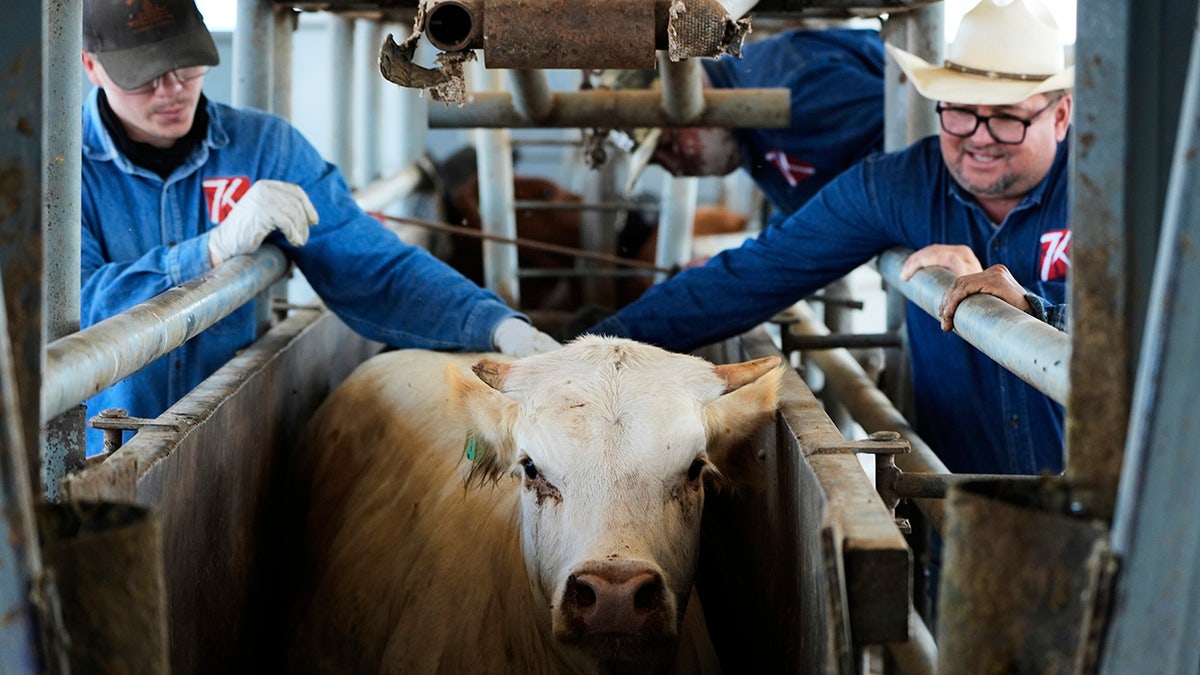
If an infection is discovered prior to the animal reaching the slaughterhouse, a veterinarian will treat the animal and disinfect the wound to prevent worsening infection.(AP Photo/Fernando Llano)
In May 2025, the USDA announced a $21 million investment to renovate a sterile screwworm fly production facility in southern Mexico, with production expected to begin as early as summer 2026.
The agency also plans to spend $750 million on a new “fly factory” at Moore Air Base in Edinburg, Texas, which is expected to open by November 2027.
Symptoms, treatment and prevention
“In the rare cases of human infection, the symptoms that should prompt someone to seek medical attention include a non-healing wound withpain, redness and swellingthat is getting worse, a sensation of movement or crawling in the wound and visible fly larvae in the wound,�
Maggots should not be removed without medical assistance because attempting to do so can leave parts of the larvae behind and worsen the infection, per the CDC.

To protect against infection, the CDC recommends wearing long-sleeved shirts and pants, hats and socks and using EPA-registered insect repellent.(iStock)
If any maggots fall to the ground, they should not be discarded in the trash, as this could spread the infestation.Instead, they should be placed in a leakproof container filled with alcohol to kill them, and adoctor should be contactedto safely remove the remaining maggots.
onelink.me/xLDS?pid=AppArticleLink&af_web_dp=https%3A%2F%2Fwww.
To protect against infection, the CDC recommends the following steps.
- Keep any open wounds covered
- Limit exposure to skin by wearing long-sleeved shirts and pants, hats and socks
- Use EPA-registered insect repellent
- Protect clothing and gear with products containing 0.5% permethrin
- Avoid sleeping outdoors or sleep in tents with screens
- Sleep indoors with closed or screened windows
![[aggregator] downloaded image for imported item #102282](https://newsview.top/wp-content/uploads/2026/07/martha_lillard_iron_lung-1024x576.jpg "Last American to use an iron lung dies at 78 years old after childhood polio diagnosis")
![[aggregator] downloaded image for imported item #102428](https://newsview.top/wp-content/uploads/2026/07/tatyana-zlotsky-ceo-of-a-place-for-mom-1024x576.png "The best time to talk to your parents about senior care — before it's too late")
![[aggregator] downloaded image for imported item #102421](https://newsview.top/wp-content/uploads/2026/07/dean-perryman-new-friends-bar-1024x576.jpg "Man turns tragic loss of best friend to suicide into urgent outreach to lonely strangers")
![[aggregator] downloaded image for imported item #102414](https://newsview.top/wp-content/uploads/2026/07/woman-teaching-class-new-language-1024x576.jpg "Learning another language may keep your brain younger, study suggests")