
![[aggregator] downloaded image for imported item #44746](https://newsview.top/wp-content/uploads/2026/02/starbucks-protesters-in-seattle-1024x576.jpg "Workers say 'I like unions, I just don't like my union' — here's what they're discovering")
This post was originally published on this site.
“I like unions.I just don’t like my union.”
Time and time again, I hear this sentiment from employees nationwide.Most will express frustration with their union officials, who’ve disappointed or even mistreated them and other members.Some tell me how they tried and failed to improve their own union from within.They imagine there’s a better union out there — one where union officials actively improve the workplace and help employees achieve some measure of personal freedom.
Polling confirms this sentiment.Gallup found that about two-thirds of Americans broadly approve of unions, but only 9% say they belong to one.
New numbers from the U.S.Bureau of Labor Statistics (BLS) corroborate these findings.Despite a minuscule increase over last year, the percentage of workers who choose to be union members remains historically low at 10% — up from an all-time low of 9.9% the previous year.
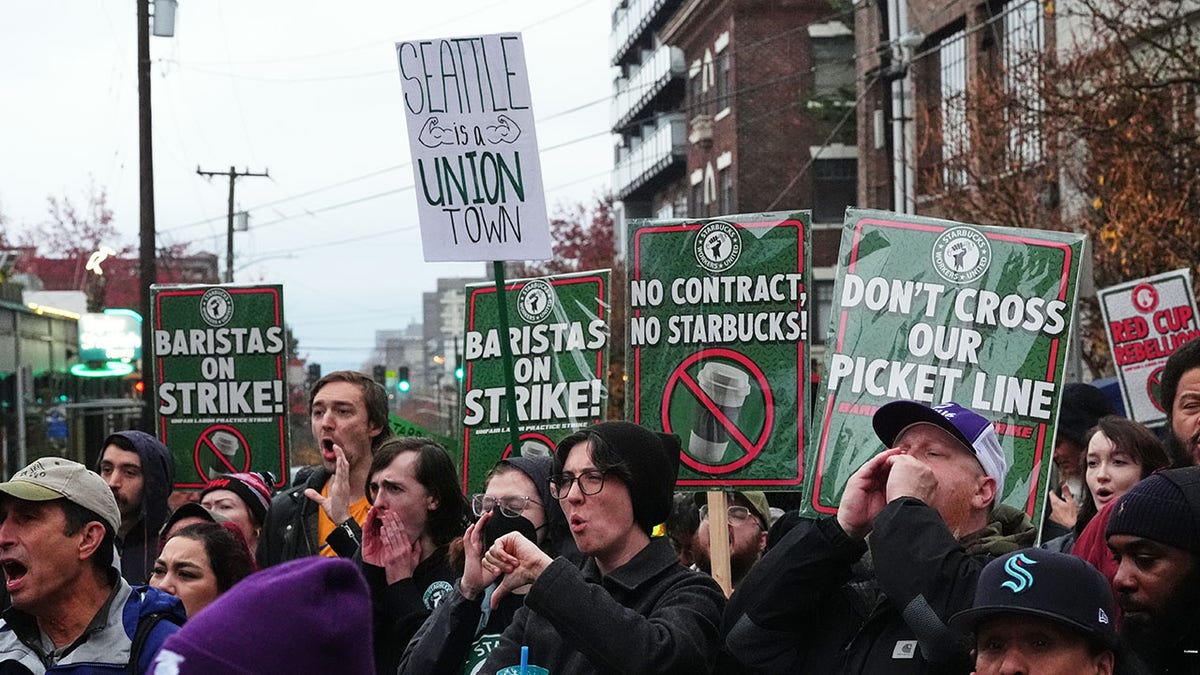
Starbucks employees and supporters strike in front of the former Starbucks Reserve Roastery that closed earlier in the year, Thursday, Nov.13, 2025, in Seattle.(AP Photo/Lindsey Wasson)
Private sector unions were especially unpopular with employees, whose membership rate held steady at a record-low 5.9%.For reference, in 1980, over 20% of all private sector employees were union members.
And it’s possible this year’s numbers overstate workers’ interest in unionizing.The National Labor Relations Board oversaw 30% fewer union elections in 2025 than it did in 2024, according to the Center for American Progress.The total number of workers participating in those elections fell even further, down 42% from 2024.
Meanwhile, in thepublic sector, the numbers tell a similar story.
TEACHERS UNION PRESIDENT CALLS TRUMP A ‘DICTATOR’ ON UNEARTHED CALL WITH ANTIFA-LINKED GROUP
According to the BLS, government employees — including teachers, state employees and city and county workers — have a much higher union membership rate: 32.9%.That marks a tiny increase since 2024 (less than a percentage point) and the first year-over-year increase since 2020.This marginal increase stems from federal and state employees’ membership rates, both of which rose by almost two percentage points.
But this relatively high unionization rate doesn’t mean their government union officials are outperforming their private sector counterparts.For one, government and private sector employees increasingly share the exact same union officials.The United Auto Workers (UAW) union, for example, represents more graduate student workers and postdoctoral researchers than any other union, and those workers — many of whom serve at public institutions — now make up a whopping 25% of UAW’s membership.By contrast, less than half of UAW’s existing members are autoworkers.
More likely, these varying private and public sector unionization rates point to the fundamental difference between the sectors.
RANDI WEINGARTEN GIVES TEACHERS GOOD ADVICE FOR ONCE
In the private sector, a strong, aggressive union can negotiate its way out of business.For example, in 2023, the International Brotherhood of Teamsters celebrated a massive victory against UPS, delivering pay increases and improved benefits for its members.Just over two years later, however, UPS cut 48,000 positions, then announced plans to cut 30,000 more.
Assuredly, external economic factors, such as tariffs, played a part.But unions aren’t off the hook.
Private sector unions were especially unpopular with employees, whose membership rate held steady at a record-low 5.9%.For reference, in 1980, over 20% of all private sector employees were union members.
“UPS is not an outlier,” writes Liya Palagashvilli, an economist with the Mercatus Center.“It is a case study in how monopoly bargaining can generate short-run wins that give way to long-run adjustment costs.”
CHICAGO TEACHERS UNION SPARKS BACKLASH WITH VIDEO HARASSING TARGET EMPLOYEES OVER ICE AS TEST SCORES PLUMMET
A literature review of 147 studies by Mercatus demonstrates that union victories can increase employer costs, resulting inhigher costsand less volume for customers.Inevitably, employers cut workers, resulting in fewer union members.
But public employers rarely cut services and never go out of business.Thus, when government unions secure increases in salary or benefits, taxpayers pay the price.In January, Teamsters secured a 13% wage increase for school administrative assistants, food services managers and plant managers in the Los Angeles School District.The school district now faces a projected $877 million deficit, but its recent layoff plans will result in only 650 layoffs, less than 1% of its 83,000 employees.
public school teachers.
onelink.me/xLDS?pid=AppArticleLink&af_web_dp=https%3A%2F%2Fwww.
Paradoxically, by befriending greedy politicians and milking taxpayers, government union executives have done a disservice not only to these teachers but also to unionized civil servants and first responders.In 2024, the four biggest government unions collectively spent $650 million on political activism and electioneering — 86% of which came from their membership dues.The deeper they get into politics, the more public sector unions have become obsessed with ideology and power, betraying the individual government employees they are supposed to represent.
Workers’ patience has worn thin.Employees continue to express their disapproval with unions by simply walking away.Until unions refocus on better serving and representing their members, rather than chasing short-term gains and political favors, union executives — and their members’ confidence in them — will continue to dwindle.

![[aggregator] downloaded image for imported item #35734](https://newsview.top/wp-content/uploads/2026/02/bad-bunny-performs-super-bowl-2-1024x576.jpg "Why Bad Bunny’s polarizing Super Bowl halftime show felt like a slap at America")
![[aggregator] downloaded image for imported item #35727](https://newsview.top/wp-content/uploads/2026/02/jeff-bezos-sitting-1024x576.jpg "How Jeff Bezos ruined the Washington Post and why he should sell it")
![[aggregator] downloaded image for imported item #35722](https://newsview.top/wp-content/uploads/2026/02/nuclear-reactor-germany-1024x576.jpg "America can’t duck and cover from Washington’s nuclear waste disposal failure")